

MCP Server
Give Claude, ChatGPT, Codex, Cursor, n8n or any AI agent the full VidNavigator API: agent skills and a hosted MCP server for video search, transcription, analysis, data extraction, TikTok and your files
VidNavigator MCP Server
The VidNavigator MCP (Model Context Protocol) server lets an AI assistant search, transcribe, analyze and extract data from online videos, and work with the files you uploaded, all from natural language. It is hosted at https://api.vidnavigator.com/mcp/ and works with any MCP client that supports HTTP servers: Claude Code, Claude Desktop, Cursor, n8n, and others.
It comes with the VidNavigator skills: Agent Skills such as /watch and /search that teach an agent when and how to use these tools. They install in Claude Code, Codex, Cursor, Gemini CLI, GitHub Copilot and the other agents that support skills.
Video search
AI-ranked YouTube search, with filters for year, duration and purpose (find videos that support or oppose a claim).
Transcripts and transcription
Transcripts from YouTube, TikTok, X, Facebook, Vimeo and more, and speech-to-text for videos without captions, Instagram included, of any length.
Analysis and data extraction
Summaries and Q&A on any video, and structured data extracted into the fields you define.
TikTok
Keyword search with sort, date, popularity and country filters, full profile scrapes, and the LIVE rooms broadcasting right now.
Tweet claim analysis
Extract the core claim of a tweet, including its attached video or images, ready to fact-check.
Your files
List, search, analyze and extract data from the files you uploaded to VidNavigator.
Quick Setup
Get your API key from VidNavigator Studio → API first. The server accepts it as Authorization: Bearer <key> or as an X-API-Key: <key> header. Claude's own apps do not need a key: they sign you in to your VidNavigator account.
Claude Code
The VidNavigator plugin is the quickest way: one install gives Claude Code the MCP server and the skills.
/watch
/watch <link> [question]: Claude reads what is said in the video and answers with timestamps.
/search
/search tiktok <keywords> for the latest or most liked TikToks, by country and period. /search youtube <request> for the videos, and the passage in them, that match.
/tiktok-live
Who is live on TikTok about a topic right now, and what one LIVE room's chat is saying.
video-dataset
Claude searches TikTok or YouTube, extracts the same fields from every video and writes a CSV file.
vidnavigator-api
Claude writes code that calls the VidNavigator API with the Python and JavaScript SDKs.
Install the plugin
In Claude Code, run:
/plugin marketplace add vidnavigator/skills
/plugin install vidnavigator@vidnavigator
Claude Code asks for your API key and keeps it in your system's secure storage.
From a terminal, the same in one command:
claude plugin install vidnavigator --marketplace vidnavigator/skills --config api_key=YOUR_API_KEY_HERECheck the connection
Run /mcp: the vidnavigator server is listed with its tools.
Start using
Type /watch and pick the suggestion (/vidnavigator:watch), or just ask: Claude uses a skill on its own when your request calls for it.
/watch https://www.youtube.com/watch?v=... give me the three key points/search tiktok AI tools, most liked this week- "Transcribe this Instagram reel and summarize it: https://www.instagram.com/reel/..."
- "Find the most liked TikToks about AI tools this week and write the creator, the views and the tools they mention to a CSV file"
Nothing is installed on your machine besides the plugin: videos are read by the hosted server, with no yt-dlp or ffmpeg. The plugin reads what is said in a video and its details (title, creator, date, views), not the picture.
To get the tools without the skills, add the server yourself:
claude mcp add --transport http vidnavigator https://api.vidnavigator.com/mcp/ --header "X-API-Key: YOUR_API_KEY_HERE"Add --scope user to have it in every project, not only the current one.
Codex, Cursor, Gemini CLI, Copilot and other agents
The same skills install in every agent that supports Agent Skills, with the skills CLI:
Install the skills
In a terminal, run:
npx skills add vidnavigator/skills -gThe installer asks which agents to install into. To name one yourself, add -a codex, -a cursor, -a gemini-cli or -a github-copilot. It requires Node.js 22.20 or later.
Add your API key
Set the environment variable VIDNAVIGATOR_API_KEY, or save the key, alone on one line, in the file ~/.config/vidnavigator/api_key. The file is the safer choice for desktop apps, which do not always see the variables of your terminal.
Start using
Restart your agent, then /watch <link>, /search tiktok <keywords> or /search youtube <request>.
The skills do not need the MCP server: when it is not connected, they call the same tools over HTTPS with a small script that is installed with them, which requires Node.js 18 or later. To give your agent the MCP tools as well, add the server as shown for Cursor below; the address and the header are the same in every client.
Claude on the web, desktop and mobile
Claude connects to the VidNavigator server as a connector and signs you in to your VidNavigator account: there is no API key to copy. The connector belongs to your Claude account, so one setup serves Claude on the web, Claude Desktop and the mobile apps, and new tools appear on their own.
Add the connector
In Claude, open Customize → Connectors, select Add, then Add custom connector. Enter a name and the address https://api.vidnavigator.com/mcp/, then continue. Keep the sign-in choice that Claude detects, add no request header, and click Add.
Sign in and allow
Click Connect. A VidNavigator page opens: sign in if you are not already, check that the application named is Claude, and click Allow.
Start chatting
Turn VidNavigator on from the + menu of a conversation, under Connectors, and ask: "Summarize this video: https://www.youtube.com/watch?v=..."
Claude gets read access: transcripts, search, analysis, data extraction and the files you uploaded, on the credits of your plan. It cannot upload, change or delete your files. The connection is listed in Studio → API as "Claude (connected app)": delete it there to end it.
On Team and Enterprise plans, an owner adds the connector for the organization, then each member connects with their own VidNavigator account.
Claude Desktop can also reach the hosted server with an API key, through mcp-remote, which requires Node.js 18 or later. Open Settings → Developer → Edit Config, add the following to claude_desktop_config.json, and restart Claude Desktop:
{
  "mcpServers": {
    "vidnavigator": {
      "command": "npx",
      "args": [
        "-y",
        "mcp-remote",
        "https://api.vidnavigator.com/mcp/",
        "--header",
        "X-API-Key:YOUR_API_KEY_HERE"
      ]
    }
  }
}
Keep X-API-Key: and the key together with no space: on Windows, a space in a header argument splits it in two and the key is lost.
ChatGPT
ChatGPT connects to the VidNavigator server as a plugin and signs you in to your VidNavigator account: there is no API key to copy.
Add the server
On chatgpt.com/plugins, select +, then Add custom MCP server. Name it VidNavigator, enter the server URL https://api.vidnavigator.com/mcp/, and choose OAuth for authentication.
Create and install the plugin
Accept the warning, select Create as a plugin, then install it from your plugins.
Sign in and allow
Use the plugin in a conversation. A VidNavigator page opens: sign in, check that the application named is ChatGPT, and click Allow.
As with Claude, ChatGPT gets read access on the credits of your plan, and the connection is listed in Studio → API as "ChatGPT (connected app)", where you can end it.
Cursor
Add the MCP server
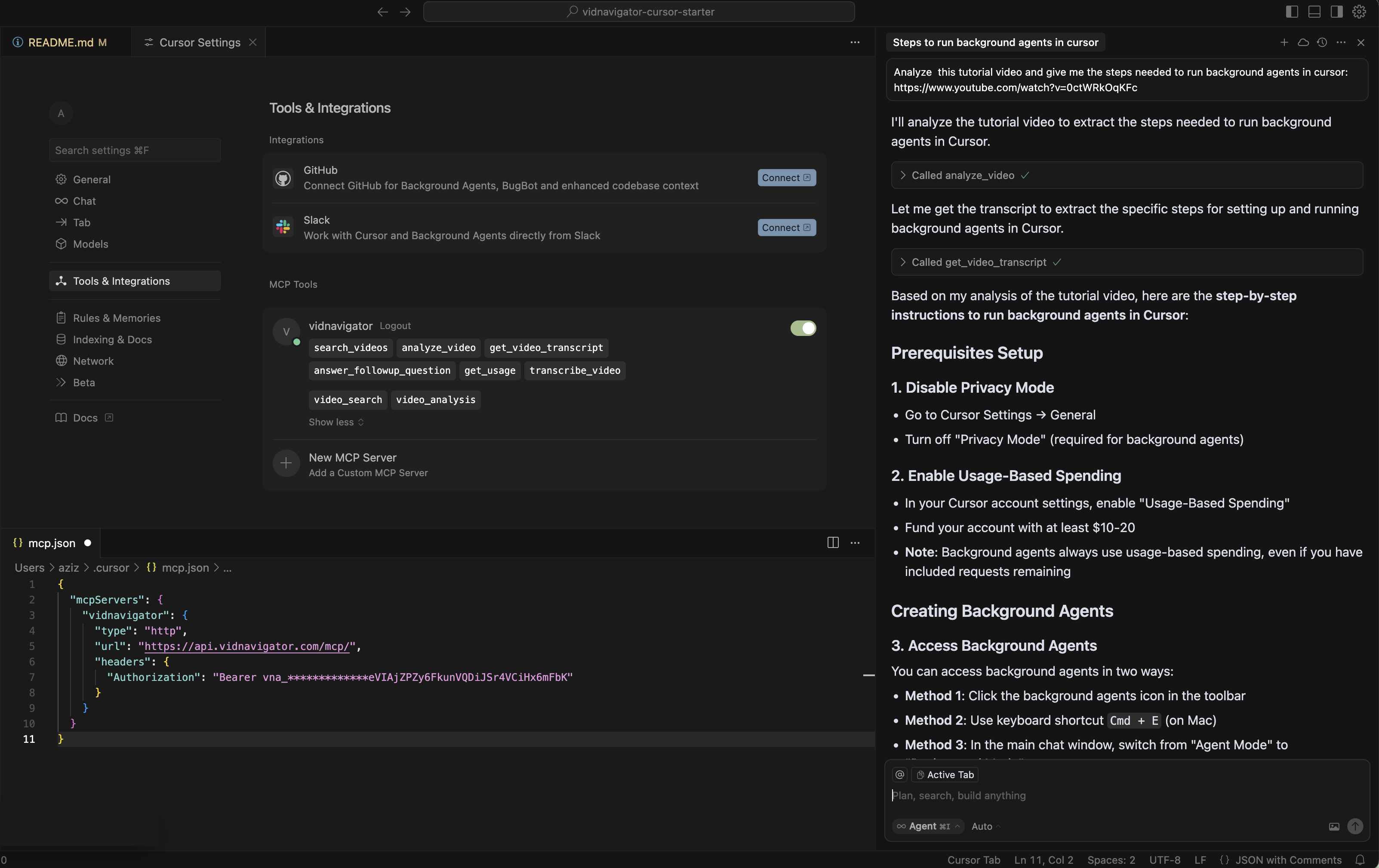
Open Cursor → Settings → Tools and integration → Add MCP server, then paste:
{
  "mcpServers": {
    "vidnavigator": {
      "type": "http",
      "url": "https://api.vidnavigator.com/mcp/",
      "headers": {
        "Authorization": "Bearer YOUR_API_KEY_HERE"
      }
    }
  }
}
Replace YOUR_API_KEY_HERE with your API key.
Start using
You can now ask things like:
- "Find a video where Neil deGrasse Tyson explains gravity"
- "Transcribe this Instagram reel and summarize it: https://www.instagram.com/reel/..."
- "Find TikToks about AI tools posted in the last 24 hours"
n8n
You can integrate VidNavigator into your own workflows with n8n, an open-source automation tool.
Watch this video to learn how to set up an n8n workflow that connects to the VidNavigator MCP server, and follow the steps below.
Create n8n Workflow
Start by creating a new, empty workflow in your n8n instance.
Configure AI Agent
Add an AI Agent node. Inside the node, connect it to your preferred Large Language Model (LLM), such as OpenAI, and configure a memory option.
Add MCP Client
Add the native MCP Client tool from n8n. This client will connect to the VidNavigator MCP server, giving your workflow access to all the available video tools.
Set Server URL
In the MCP Client node, set the Server URL to https://api.vidnavigator.com/mcp/ and ensure the transport is set to HTTP Streamable Server.
Authenticate Your Client
In the MCP Client node, set up a header with the name X-API-Key and paste your API key as the value.
Connect and Use
Connect the MCP Client to the AI Agent. You can now send natural language prompts to the AI Agent to search, analyze, or transcribe any online video.
How long-running tools work
Transcription, watching, the analysis of a video with its scenes, data extraction, tweet analysis, and the TikTok search, LIVE search and profile tools can take from a few seconds to several minutes, depending on the video. They run as background jobs, so no video is too long:
- The tool returns a
task_idright away. - The assistant calls
get_task_status, which waits for the job, untiltask_statusiscompleted, which includes the result, orfailed, which includes an error with a code and a message.
The tool descriptions tell the assistant to do this, so you just ask your question and wait for the answer. Polling is free, and results are kept for one hour after the job finishes. If you set a default webhook in Studio → API, it is also called when each job finishes.
Available Tools
Online videos
AI-ranked YouTube search. Filters: year range, maximum duration, focus (relevance, recency, popularity, brevity) and purpose (support, oppose, illustrate, example, explain). max_results caps how many videos are analyzed, and so the cost.
Example: "Find videos that explain how mRNA vaccines work, under 10 minutes"
The transcript of a YouTube, TikTok, X, Facebook, Vimeo, Dailymotion or Loom video, as timestamped segments or plain text. Can also return the video's metadata only.
Example: "Get the transcript of https://www.youtube.com/watch?v=..."
Speech-to-text for videos without captions: Instagram, TikTok, X, Facebook, Vimeo, Rumble, Loom and more, of any length. Can transcribe every video of an Instagram carousel at once. Runs as a background job.
Example: "Transcribe this Instagram reel: https://www.instagram.com/reel/..."
What a video shows, scene by scene, next to what it says: for each scene its start and end, a description of the picture and the text on screen, plus the transcript. Works on YouTube, TikTok, Instagram, X, Facebook, Vimeo and more. Runs as a background job.
Example: "Watch this TikTok and tell me what is written on screen: https://www.tiktok.com/@.../video/..."
Summarize a video, or answer a question about it, with the people, places and key subjects it covers and the moment that best answers the question.
With include_scenes, the answer also uses what the video shows: its scenes and the text on screen. Ask for it when the answer may be on screen rather than said, or when the video has little or no speech. The analysis then runs as a background job, and the frames are charged on top of it (1 credit per 2,000 frames analyzed, with at least 667 frames per hour of video).
Example: "Summarize this video and tell me what it says about pricing"
Ask another question about a video you already analyzed.
Example: "What did the speaker say about the main challenges?"
Extract structured data from a video into fields you define: products and prices, people mentioned, sentiment, claims, and so on. The video is transcribed first when it has no captions. Runs as a background job, and returns the video's metadata with the extracted data.
The fields can be given as a JSON Schema, or just described in plain words: the schema is then written from your request and returned with the data, so the assistant can reuse the same fields on the next videos.
With include_scenes, the fields can also be filled from what the video shows: a price on screen, a product, a caption. The frames are charged on top of the extraction.
Example: "From this product review, extract the product name, the price and the pros and cons"
Extract the core claim of an X/Twitter post, with its topics, entities, tone and intent. Attached videos are transcribed and images are described. Chain it with search_videos to find videos that support or contradict the claim. Runs as a background job.
Example: "Fact-check this tweet: https://x.com/.../status/..."
TikTok
TikTok keyword search, with each video's author, stats (views, likes, comments, shares) and publish date. The assistant picks the filters from your request: newest videos for "latest" or "since" requests, most liked for "viral" or "popular" requests, and a publication window such as this week or this month. Runs as a background job.
Example: "Find the most liked TikToks about skincare routines this week"
Scrape the videos of a TikTok profile, optionally limited by date, likes or number of posts. Runs as a background job.
Example: "Get the last 30 videos posted by https://www.tiktok.com/@nasa"
The TikTok LIVE rooms broadcasting right now for a keyword, in the country you choose, with each room's streamer, viewers, likes, hashtags and category. A keyword with no LIVE at that moment returns no room. Runs as a background job.
Example: "Who is live on TikTok about skincare right now in the UK?"
One LIVE room, by streamer, by link or by room id: whether it is live or has ended, how many people are watching, and on request the latest comments of its chat (up to 50), its pinned comment and its top viewers. Answers right away.
Example: "Is @nasa live on TikTok right now, and what are viewers saying?"
Your files
Browse the files you uploaded to VidNavigator, read their transcripts, and list the namespaces they are organized into.
Example: "List my uploaded files that finished processing"
Semantic search across your uploaded files, with a direct answer, the relevant quote and its timestamps.
Example: "In my customer calls, what did people say about the onboarding?"
Summarize an uploaded file, answer a question about it, or extract structured data from it.
With include_scenes, what the file shows is used as well. The scenes of a file are analyzed once and kept with it: when they are not there yet, the tool starts their analysis and the assistant asks again a few seconds later. The frames of a file are charged once (1 credit per 2,000 frames analyzed, with at least 667 frames per hour of video).
Example: "Extract the action items and owners from my last meeting recording"
Tasks and account
Get the status, and then the result, of a background job. The call waits up to 20 seconds for a job that is still running, and the assistant calls it again if needed, on its own, after the tools that run as background jobs.
Your credit balance, activity for the current billing period, storage and channels indexed.
Example: "How many VidNavigator credits do I have left?"
Example Queries
"Find a video where Neil deGrasse Tyson explains gravity"Credits & Usage
Every tool draws from your plan's shared credit pool, exactly like the equivalent API endpoint: YouTube search and TikTok search are billed per video or page fetched, transcription per audio hour, and analysis and extraction per AI analysis. Polling a background job is free. Ask the assistant to check your balance at any time with get_usage.
Support
Need help with the MCP server setup or have questions?
GitHub Repository
The skills, the plugin and their source code
GitHub Issues
Report bugs or request features
Postman Collection
Test the MCP server API endpoints